
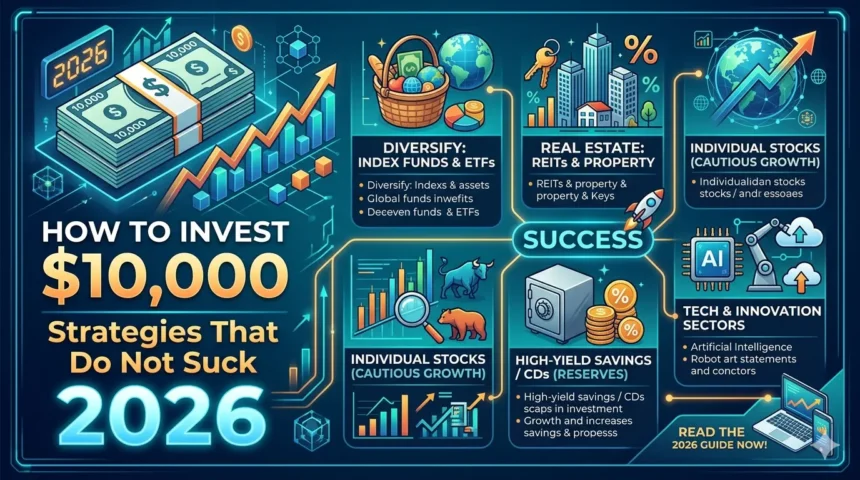
You have $10,000. It sits in your checking account earning nothing. Friends say stocks. TikTok says crypto. Your bank offers 4.5% on a CD. Now what?
Nobody tells you the first rule: do no harm. $10k is real money. One bad move wipes out a year of saving. But leaving it idle loses to inflation, which nibbles about 2.5% a year based on recent CPI data.
This guide cuts through the noise for U.S. folks in 2026. We focus on strategies that match your timeline, risk comfort, and goals. Whether you need the cash soon or can let it ride ten years, there are paths that work without turning you into a day trader.
Investing $10k is less about genius and more about not being stupid.
We will break down mechanics, compare options, and give steps so you pick a plan today. No hype. Just what holds up when markets get weird.
The Thing Nobody Actually Says Out Loud
$10,000 feels like a fortune until you realize it is not life-changing on its own. The real talk is that investing it wrong can sting more than doing nothing. Markets drop 20% or more every few years. If you panic-sell, you lock in losses.
With $10k, patience beats prediction every time.
Articles push “top stocks” or “10x crypto plays.” That works for pros with time and edges. For you, it is gambling. A Vanguard study shows 82% of active funds underperform indexes over 15 years. Why bet against that?
You think you want excitement. What you need is sleep-at-night allocation. Split across stocks, bonds, cash based on your age and needs. Boring? Yes. Effective? Absolutely.
Like choosing a car. You could buy a sports car that looks cool but guzzles gas and breaks down. Or a reliable sedan that gets you there every day. $10k investing is the sedan choice index ETFs over hot tips.
Nobody admits how taxes sneak up. Short-term gains tax at your income rate, up to 37%. Long-term drops to 5%−20%. Hold a year, save big. Beginners sell too soon, handing Uncle Sam extra.
Inflation is the silent thief too. At 2.5%, your $10k buys less every year. High-yield savings beat it now, but stocks average 7%−10% after inflation long-term. Short-term, cash wins.
One more thing: fees kill returns. A 1%annual fee on $10k costs $30k over 30 years.
The beginner trap is “all in” thinking. Put it all in Nvidia because AI is hot. Then AI cools, and you are down 30%. Diversify across 1,500 companies via VTI. One company tanks? Meh.
Real observation: most $10k investors do fine if they pick low-cost ETFs and ignore headlines. The ones who struggle chase returns, trade often, or pull out during dips. Markets reward sitting tight.
How This Actually Works — The Real Mechanics
Investing $10k means putting money into assets that grow or pay income. Stocks rise with companies. Bonds pay interest. ETFs bundle them cheaply.
The niche most skip: tax drag on small sums. With $10k, Roth IRA maxes at $7k if eligible. Use it for tax-free growth. Traditional IRA for deductions if higher earner.
Mechanics tie to daily life like this: $10k is three months’ expenses for many. If needed soon, park in cash. If for retirement, tilt stocks.
Key pieces every beginner misses:
- Dollar-cost averaging spreads buys over time, buying more when cheap. Lowers average cost versus lump sum timing.
- Expense ratios under
- 0.1% matter. $10k at
- 0.03% saves $70 year one versus
- Rebalancing yearly keeps risk steady. Sell winners, buy laggards. Forces discipline.
- Dividends reinvest automatically in many accounts. Compounds quietly.
- Withdrawal rules: Roth anytime after 5 years tax-free. 401k penalties before 59.5.
Connect to life: imagine $10k as a down payment fund. HYSA at 4.8% grows it safely. Or retirement seed: 60/40 stock/bond ETF mix.
Generic guides ignore 2026 yields. CDs at 4.5%−5% for 1-year. Treasuries similar. Stocks volatile but higher long-run.
Comparison — What’s Actually Different Between Your Options
| Option | What it actually does | Who it’s for | The catch |
| High-yield savings/CD | Earns 4%−5% interest, FDIC insured | Short-term needs (1-3 years) | Barely beats inflation long-term |
| S&P 500 ETF (VOO) | Tracks 500 big U.S. stocks, avg 10% historical | Medium/long-term (5+ years) | Drops +20%+ in bad years |
| Total market ETF (VTI) | Broader U.S. stocks, low 0.03% fee | Diversified growth seekers | Still volatile, no bonds |
| Bond ETF (BND) | Pays steady interest, lower risk | Conservative or income focus | Low growth, rates fall hurts |
| Robo-advisor (60/40) | Auto-allocates stocks/bonds, rebalances | Hands-off beginners | 0.25% fee, less control |
Go with total market ETF like VTI for most $10k lumps under 40. Pair with cash buffer. Reliable growth without fuss. Avoid all-bonds unless cash needed soon.
What Actually Happens When You Try This
You open a brokerage. Transfer $10k. Buy VTI. Market rises 5%. Feels great. Then drops 10%. Stomach turns.
Surprise: the drop feels worse than gains feel good. Behavioral finance calls it loss aversion — losses hurt twice as much. You check daily, tempted to sell.
Pattern articles miss: small investors hold through one dip but bail on the second. Data shows lump-sum beats dollar-cost 68% times, yet people time anyway.
Taxes bite first sale. $1k gain at 15% long-term? $150 owed. Track basis carefully.
Rebalancing feels wrong. Sell stocks high? Counterintuitive. But it works.
In practice, $10k in VTI from 2016 grew to $35k by 2026 despite crashes. The holders won. Fidgeters lost.
The Advice Everyone Gives vs What Actually Works
“Invest in what you know.” Fine for Buffett. Beginners “know” Netflix from bingeing, not business. Result: emotional sells. Better: broad ETFs. No stock-picking needed.
“Lump sum now.” Often best mathematically. But if markets peak, psychologically brutal. Alternative: spread over 6 months. Sleep better.
“All stocks for growth.” Ignores sequence risk. Retiree down 30% hurts withdrawals. Match to timeline: 110-minus-age in stocks.
“Do not touch it.” Smart, but opportunity cost if idle. Build 3-6 months cash first, invest rest.
Opinion: boring index funds crush hot tips for $10k.
The Practical Part — What To Actually Do
Check timeline. Need money in 2 years? HYSA/CD. 5+ years? ETFs. Write it down.
Build emergency fund first. If short, add to cash until 3 months covered. Protects investments.
Open Roth IRA if eligible. Contribute $7k max. Rest in taxable brokerage. Tax advantages compound.
Buy VTI ($6k), BND ($3k), cash ($1k) for balance. Use Fidelity/Vanguard.
Set calendar reminder: rebalance January 1. Sell high, buy low.
Dollar-cost $500 monthly if nervous about lump. Reduces timing stress.
Track in app/spreadsheet. Monthly review, no trades.
So Where Does This Leave You
$10k is a solid start, not a jackpot. Markets reward time and discipline over smarts. Volatility comes. Inflation waits for no one.
Today: open Fidelity account, buy $6k VTI, $4k BND. Done. Builds habit without overwhelm.
Not easy. Dips test you. But this path works for regular folks.
Conclusion
You read the whole thing. Props.
Line that sticks: invest like the house, not the gambler. Steady wins.
See you on the other side of the next dip.