
You know the moment. The car needs tires, the dentist finds “a little something,” and your bank account suddenly develops a strong sense of humor. So now you’re staring at two very American options: a personal loan or a credit card, both promising relief and both quietly waiting to charge you for the privilege.
The annoying part is that this is not really a “which is better?” question. It’s a “what kind of expensive are you willing to live with?” question. And those are not the same thing. One of these tools can help you escape high-interest messes. The other can be great for short-term flexibility and terrible for people who like to tell themselves, I’ll pay it off next month.
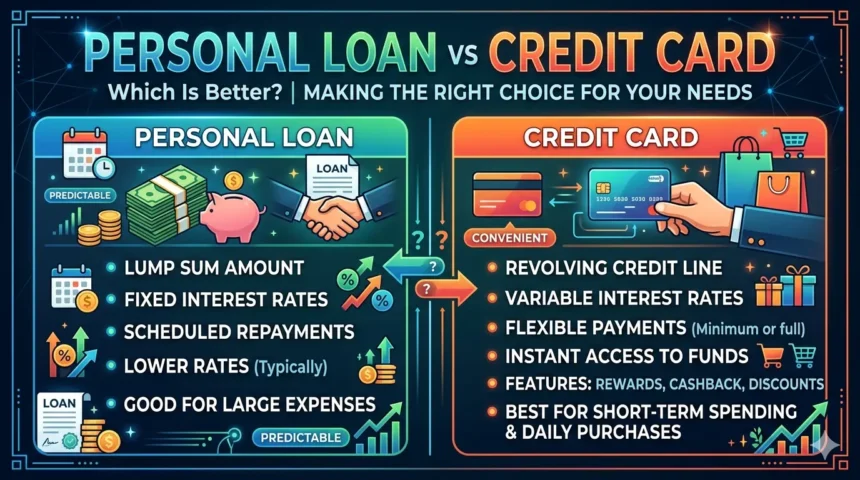
If you want the clean answer, here it is: a personal loan is usually better for fixed, one-time debt or a planned expense with a timeline. A credit card is usually better for short-term spending, rewards, and emergencies you can pay back quickly. The tricky part is that “usually” does a lot of work here.
The Thing Nobody Actually Says Out Loud
Most articles talk about APRs like that ends the conversation. It doesn’t. The real question is whether you need structure or flexibility, because that’s what you’re actually buying.
A personal loan is a straight line. You borrow a set amount, you get a fixed payment, and you know when the whole thing ends. That matters more than people admit. If you’re the kind of person who likes a finish line, a personal loan can feel like relief, not just debt. The payment is the same every month, which means your brain can stop renegotiating with itself every payday.
A credit card is different. It’s a revolving line of credit, which is a polite way of saying the balance can stick around as long as you keep making minimum payments. That flexibility is useful, and also dangerous in the way a couch and a snack drawer are dangerous. The card doesn’t force you to solve the problem. It lets you delay it.
The best choice is often the one that makes bad habits harder to repeat.
That’s why debt consolidation is where this debate gets real. If you’re using a personal loan to wipe out credit card balances, you’re not just chasing a lower rate. You’re buying discipline. You replace five card payments with one loan payment, one payoff date, and less room to improvise. That can be a lifesaver if you’ve been playing the minimum-payment game for a while.
But here’s the part people skip: if you pay off cards with a personal loan and then rack the cards back up, you’ve managed to do both steps of the financial equivalent of cleaning your kitchen and then setting it on fire. Very efficient, if your goal was emotional growth through repetition.
Credit cards win when the spending is temporary and the payoff is fast. Think airfare you’ll reimburse next month, a small emergency, or a purchase you can clear before interest gets a chance to chew on it. They also win if you are disciplined enough to capture rewards without carrying a balance. That part is rare enough to be suspicious, but yes, it exists.
The honest truth is that this choice is less about the product and more about the borrower. A person with steady cash flow and strong habits can make either option work. A person with uneven income, old balances, or a habit of saying “I’ll handle it later” usually needs structure more than options.
How This Actually Works — The Real Mechanics
A personal loan gives you a lump sum upfront. You repay it in fixed monthly installments over a set term, often between two and seven years. Most personal loans in the U.S. are unsecured, which means no collateral, but also usually higher rates than secured borrowing. Lenders look at your credit score, income, debt-to-income ratio, and sometimes your job stability before they decide what rate you get.
Credit cards work on revolving credit. You have a limit, you borrow against it, and your available credit changes as you pay it down. If you carry a balance, interest compounds daily or monthly depending on the card terms, and the minimum payment can be tiny compared with the actual debt. That’s why a balance can feel strangely alive. It moves, but not in a helpful direction.
The niche detail people miss is timing. With a personal loan, the payment schedule is built in from day one. With a credit card, the payoff speed is almost entirely up to you. That means the same $5,000 balance can behave like two very different problems depending on whether you pay it down aggressively or just skim the minimum.
A few practical things matter more than the brochure language:
- Fixed payment, fixed end date: Personal loans are easier to plan around, and your budget usually likes that more than you do.
- Variable payoff pace: Credit cards let you pay fast or slow, which sounds nice until “slow” turns into a year-long hangover.
- Rate promos: Some cards offer
- 0% intro APR on balance transfers, which can be excellent if you pay the debt off before the promo ends.
- Fees: Personal loans may have origination fees, and balance transfers usually have a fee too. The lowest headline rate is not always the lowest actual cost.
- Credit use impact: A loan can lower your card utilization if it replaces revolving debt, which is one reason people use it for consolidation.
- Access speed: Credit cards are usually faster for same-day spending; personal loans often take longer to apply, approve, and fund.
One real-life observation: people tend to underestimate how much they value predictability once they’re already stressed. A fixed payment can feel boring in the best possible way. Boring is underrated when money is already doing acrobatics.
Comparison
| Option | What it actually does | Who it’s for | The catch |
| Personal loan | Gives you a lump sum with fixed payments and a set payoff date | People consolidating debt or funding a large one-time expense | May include origination fees and usually less flexibility |
| Credit card | Gives you revolving credit you can use, repay, and reuse | People covering short-term expenses or earning rewards | High APR if you carry a balance, and minimum payments can trap you |
| Balance transfer card | Moves existing card debt to a card with a low or 0% intro rate | People with decent credit who can pay off debt during the promo window | Transfer fees and the promo rate eventually expires |
My take: if the balance is already sitting on a credit card and you need a real exit, a personal loan is often the cleaner choice. If the expense is small, temporary, or you can pay it off quickly, a credit card is usually fine and sometimes smarter.
What Actually Happens When You Try This
When you actually try to choose between these two, the decision rarely comes down to a perfect spreadsheet. It comes down to whether you trust your future self. That sounds dramatic, but it’s basically the whole thing.
If you take a personal loan to pay off credit cards, the first surprise is how calm the budget feels afterward. One payment replaces several, and that alone can lower the mental noise. The second surprise is how fast the wrong habits try to sneak back in. The card balances are gone, the cards still work, and if you haven’t changed your spending pattern, the loan can become a second bill sitting next to new card debt. That is not a win. That is a sequel nobody asked for.
If you use a credit card for an emergency, the good version looks neat and temporary. A tire replacement, a vet bill, a flight home, a broken appliance. The bad version is when the emergency was real, but the repayment plan was fictional. Then the card becomes a slow leak. You make payments, sure, but the balance barely moves because interest keeps taking a bite.
One pattern most articles miss: people often choose based on the approval they can get, not the product they actually want. Someone with fair credit may get a personal loan offer at a rate that looks better than the card they already have. Someone else may get approved for a card with a flashy promo rate and then miss the fine print on balance transfer fees. The “best” option on paper can be the worst one in practice if the terms are awkward for your actual life.
Another thing worth saying plainly: when cash flow is tight, the payment size matters almost as much as the rate. A lower APR with a payment that strains your budget is not useful if it causes late fees elsewhere. The cheapest debt is the one you can actually keep current.
The Advice Everyone Gives vs What Actually Works
People love saying, “Always use the lowest interest rate.” That advice is incomplete. Rate matters, but only after you ask whether the payment structure fits your life. A cheap loan with a payment you can’t sustain is still a problem. The better move is to compare total cost, monthly payment, fees, and payoff timeline together.
Another common line is, “Put everything on a credit card for the points.” That works only if you pay the statement balance in full every month. Rewards are not free money if you’re carrying interest. The realistic alternative is simple: use the card for spending you already budgeted for, then autopay the full balance. If you need time to pay, rewards are a distraction, not a strategy.
Then there’s the classic, “A personal loan is always better for debt consolidation.” Not always. If your existing card debt is small and you can clear it quickly, a balance transfer with a 0% intro period may cost less than a loan. But if your payoff timeline is uncertain, the personal loan’s fixed term is usually safer because it stops the “I’ll get to it later” problem.
A fourth one gets repeated a lot: “Credit cards are for emergencies.” Only if you mean emergencies you can repay fast. Otherwise, the card is just a very expensive bridge. A real alternative is building a cash buffer first, even if it’s only $500 to start. That changes what counts as an emergency and keeps you from borrowing every time life gets weird.
My actual opinion? If you’re carrying existing card debt, start by asking whether you need lower interest or more structure. Most people think they need the first thing, but it’s the second thing that saves them.
The Practical Part — What To Actually Do
First, total up the full debt cost, not just the monthly payment. Write down balance, APR, minimum payment, fees, and expected payoff time for each option. The only number that matters is what you’ll pay in the end, not the one that looks nicest in a bank app.
Second, check whether you qualify for a balance transfer card before you jump to a loan. If your credit is good and the debt is mostly credit-card debt, a 0% promo can be powerful. Just make sure you know the transfer fee and the exact date the promo ends, because that cliff is real.
Third, use a personal loan if you need a hard stop. If your biggest problem is that debt stays open forever, fixed payments are the point. The loan should reduce chaos, not just change the logo on the bill.
Fourth, do not keep old cards open and spend on them casually if you used a loan to consolidate debt. You can leave them open for credit history if that makes sense, but the spending behavior has to change. Otherwise, you’re rebuilding the same pile in a different room.
Fifth, set autopay for at least the minimum on whichever option you choose. Missed payments wreck cheap debt quickly. One late fee and one interest spike can erase a lot of the benefit you thought you were getting.
Sixth, if your income is irregular, favor flexibility carefully. A card may help during an uneven month, but only if you already have a repayment plan. A fixed loan can be great for budgeting, but only if the monthly payment is truly manageable during your slow months too.
Seventh, if you’re borrowing for a purchase, ask one boring question before signing: “Would I still buy this if I had to pay cash?” That one question kills a lot of useless debt before it starts.
So Where Does This Leave You
If you want the blunt version, here it is: personal loans are better for structure, credit cards are better for flexibility, and most expensive mistakes happen when people confuse the two. A personal loan can help you clean up debt or fund a big purchase with a clear end date. A credit card can help with short-term spending, but it becomes ugly fast when you treat it like a long-term loan.
So the one thing you can do today is this: list your current debt or planned purchase, write down the APR, fee, monthly payment, and payoff timeline for both options, and compare the actual total cost. Not the marketing. The real number. Money has a way of sounding simpler right before it gets expensive.
Conclusion
You made it through the whole thing, which either means you care about your finances or you got stubborn halfway in. Fair enough.
The real answer to personal loan vs credit card is not glamorous, and that’s probably why it works: choose the tool that makes your next six months less chaotic, not the one that looks smartest in a headline.