
The Invisible War: Why Sulfur (Not Oil) is the Real Threat to Global Tech and Defense ?
While the world watches oil prices, a silent crisis in the Periodic Table is crippled by the blockade of the Strait of Hormuz. Without sulfur, the world’s copper, chips, and weapons systems are grinding to a halt.
The Crisis You Can’t See
When we talk about the Strait of Hormuz, the conversation usually starts and ends with oil. But oil is merely the visible crisis. The invisible warhead currently exploding across global supply chains is Sulfur.
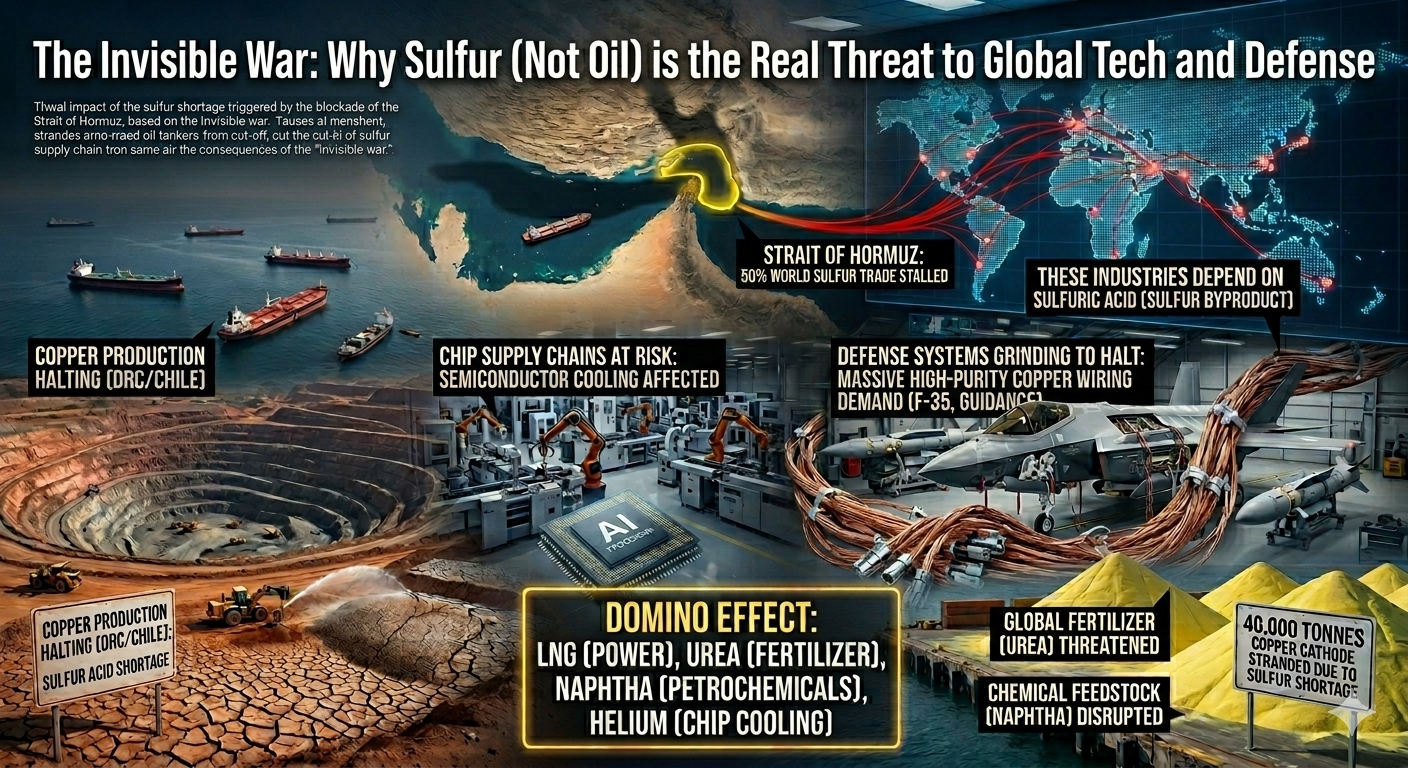
The Strait of Hormuz handles 45 to 50 percent of the world’s seaborne sulfur trade. As a byproduct of Gulf oil and gas refining, sulfur is the lifeblood of the global Sulfuric Acid supply chain. Without it, the “Green Revolution” and the “AI Race” are nothing more than expensive dreams.
From the Gulf to the Congo: The Copper Connection
The most critical victim of the sulfur shortage is Copper cathode.
- The Process: In mines across the DRC, Zambia, Chile, and Indonesia, sulfuric acid is sprayed over oxide ore in a process called heap leaching.
- The Math: To produce 1 tonne of 99.99% pure copper cathode, you need 3 to 3.5 tonnes of sulfuric acid.
- The Result: 20-25% of the world’s copper comes from this acid-intensive process.
With the IRGC controlling the strait and sulfur shipments stalled, sulfur prices have doubled since February 28—the largest rally on record.
The $1.5 Trillion Defense Headache
This isn’t just about plumbing or electrical wires in your home. The US defense budget and the global AI race are tethered to this “invisible” molecule.
- Military: F-35 flight control systems and modern missile guidance require massive amounts of high-purity copper wiring.
- Technology: iPhone charging cables, hospital ventilators, and the massive data centers required for AI are all facing a surge in input costs.
“According to recent reports on defense supply chain vulnerabilities, the F-35 program is heavily dependent on high-purity copper, which is now at risk due to the sulfur shortage.”
While copper prices fall on global growth fears, the cost of producing that copper is skyrocketing. The economics of leaching are collapsing.
The Domino Effect: Beyond the Periodic Table
Sulfur is just the first crack in the glass. The closure of the Strait has triggered a radiation of damage through other “invisible” commodities:
- Helium: Essential for semiconductor cooling.
- Naphtha: The feedstock for the entire petrochemical industry.
- Urea: The base for global fertilizers, threatening food security.
- LNG: Powering Asian grids that manufacture the world’s electronics.
Conclusion: The Molecular Bond of War
The world is interconnected by molecular bonds, not just political ones. The war in the Gulf is not just repricing energy; it is repricing the very base metals that conduct electricity in every system civilization operates.
As insurance premiums for Gulf shipping surge by 300 percent, 40,000 tonnes of copper cathode sit stranded in Dubai’s Jebel Ali hub. The sulfur crisis doesn’t care about headlines or tweets—it only cares about the fact that the chain is broken.
The verdict is clear: If Hormuz doesn’t open, the “Stone Age” won’t be caused by a lack of fuel, but by a lack of the chemistry that keeps the modern world wired.