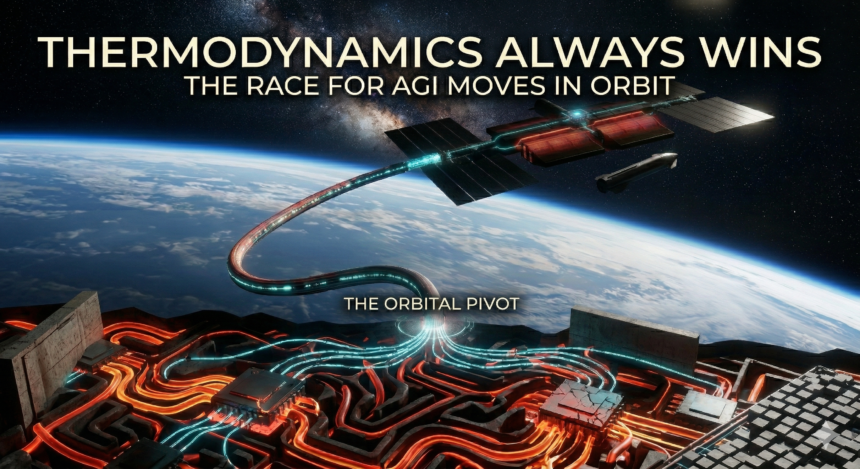
The Heat Wall: Why the Race for AGI Will Be Won in Orbit: While every AI company fights for grid power and GPU clusters, one company is betting on a single law of thermodynamics to bypass the limits of Earth: The Fourth Power of Temperature.
I. The Cooling Wall: Silicon’s Self-Destruction
The world thinks the constraint on Artificial General Intelligence is electricity. It isn’t. The true constraint is Heat.
From xAI’s “Colossus” supercomputer in Mississippi to the massive clusters planned globally, a staggering fraction of a gigawatt isn’t used for “thinking”—it’s used for surviving. Chillers, cooling fans, massive water loops, and heat exchangers are the only things preventing billions of dollars of silicon from destroying itself with its own waste energy.
- The Grid Crisis: Data center electricity demand is projected to double to 945 Terawatt-hours by 2030 (IEA).
- The Permitting Trap: Every new gigawatt of cooling requires permits from local communities that increasingly do not want the noise, infrastructure, or massive water usage.
- The Lead-Time Death: Transformer lead times now run to three years; grid queues stretch to four.
On Earth, cooling scales linearly. To double your computation, you must double your fans, your water, and your infrastructure. You are fighting the atmosphere, and the atmosphere is winning.
II. The Orbital Pivot: Terafab and the Vacuum Advantage
This is why, on March 21, Elon Musk signaled a radical shift: 80% of Terafab’s planned compute output will go to space. This is not a “marketing” gimmick; it is a fundamental bet on a single, powerful law of physics.
The Physics of the Vacuum: In the vacuum of space, you don’t need fans or water. Radiation is the only cooling mechanism. Crucially, radiated power does not scale linearly. Because of the Stefan-Boltzmann Law, radiated power scales with the fourth power of temperature.
- The Thermal Advantage: If you raise a silicon chip’s operating temperature from 80°C to 120°C, your radiated power per square meter nearly doubles. You didn’t add hardware; you just let physics do the work for you.
- The Efficiency: On March 22, SpaceX confirmed that its 100-kilowatt AI Mini Satellite render shows a radiator of approximately 100 square meters. In orbit, energy collection requires vast area, but heat rejection is compact and efficient.
- The Ultimate Heat Sink: Earth’s atmosphere is a thermal blanket. In vacuum, the heat sink is the cosmic microwave background at nearly absolute zero. It is infinite, free, and already built.
III. Scaling to the Terawatt: The Starship Economy
Skeptics call the idea of a “Terawatt of Compute” in orbit absurd. But the math of the “Starship Economy” says otherwise.
While the entire U.S. grid runs on roughly 0.5 Terawatts, Terafab is targeting 1 Terawatt. Achieving this requires tens of thousands of Starship flights—a feat that becomes practical when you realize:
- Propellant is Cheap: Launch costs are falling toward single-digit millions per flight.
- Reusability is Proven: On March 30, Falcon 9 booster B1067 flew its 34th mission. The Starship system is designed to take this to an industrial scale.
- No Grid Required: In orbit, the Sun delivers 1,366 watts per square meter continuously with zero weather and zero night.
IV. Conclusion: The Victor Solves Thermodynamics
The race for AGI will not be won by the company with the most GPUs. It will be won by the company that solved thermodynamics.
There is exactly one company that plans to manufacture its own silicon, launch it on its own rockets, and reject its waste heat into infinity using the power of the fourth-power exponent. Every other AI lab is building bigger fans. Terafab is building a bigger radiator.
The Winner’s Equation:
- Terrestrial AI: Compute + (Linear Cooling + Community Permits) = Stagnation.
- Orbital AI: Compute + (Radiative Cooling + Infinite Heat Sink) = Infinity.
Remember the exponent. That is where the war is won.